
Maybe you have looked over your paycheck and asked yourself why the figures for your gross pay and for your take-home pay rarely line up, right? Well, FICA is probably one of the major reasons. That figure marked as FICA or OASDI/EE stealthily reduces your income every single payday, and many workers are clueless about what it really finances, the method of calculation, or the reason why both they and their employer are contributing to it. If you are looking for a reliable free pay stub generator, you can easily create accurate and professional pay stubs in just a few clicks without any hassle.
This guide literally answers all of that. From defining FICA and its historical background to the exact 2026 rates, how to make step-by-step calculations, and a comprehensive list of who pays FICA taxes and who does not, everything you require to grasp this fundamental payroll tax is here.
What is FICA?
FICA stands for the Federal Insurance Contributions Act, a United States federal law that orders payroll tax contributions to fund two cornerstone programs: Social Security and Medicare.
Each time you earn a paycheck as an employee in the United States, a fixed percentage of your wages is automatically withheld for FICA taxes. Your employer matches that amount dollar-for-dollar and sends the combined totals to the IRS.
What is FICA on my paycheck?
If ever asked what is FICA on my paycheck, most of the employees see it as an unfamiliar abbreviation on their pay stub that relates to FICA withholding.
When you see the terms such as EE on your pay stub, it is your contribution to FICA taxes. The EE means employee, so you can see your contribution as compared to the employer’s contribution marked ER.
| Pay Stub Label | What does it mean? |
| FICA | General label for Social Security |
| Fed OASDI | Federal Old-Age, Survivors & Disability Insurance |
| Fed MED | Federal Medicare Tax |
| SS Tax | Social Security Tax |
| Medicare Tax | Medicare Tax |
What does FICA tax include, and how does it work?
FICA tax stands for the Federal Insurance Contributions Act tax. It is a mandatory payroll tax in the United States that helps fund Social Security and Medicare programs.
What does FICA Tax Include?
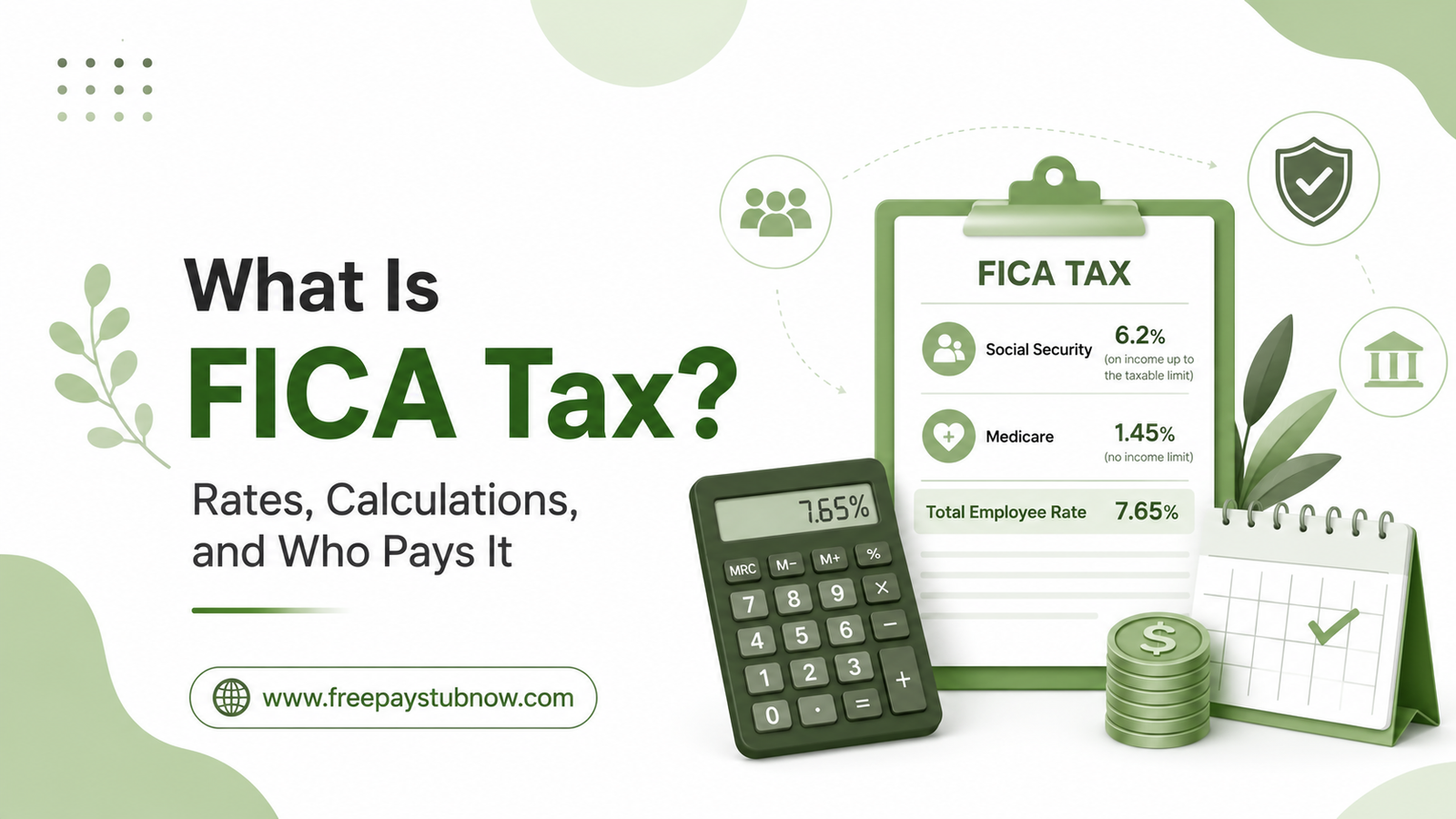
| Tax Type | Employee Rate | Employer Rate | Purpose |
| Social Security Tax | 6.2% | 6.2% | Funds retirement and disability benefits |
| Medicare Tax | 1.45% | 1.45% | Funds healthcare coverage for eligible individuals |
| Total FICA Tax | 7.65% | 7.65% | Combined Social Security and Medicare contributions |
How does the FICA tax work?
When you receive a paycheck:
- Your employer calculates your taxable wages.
- The required FICA taxes are withheld from your earnings.
- Your employer contributes an equal amount.
- Both portions are sent to the U.S. government through the Internal Revenue Service
Example:
If you earn $1,000 in gross wages:
- Social Security tax: $1,000 × 6.2% = $62
- Medicare tax: $1,000 × 1.45% = $14.50
- Total employee FICA tax: $76.50
Your employer also contributes $76.50, making the total FICA applicable contribution $153.00.
Who pays FICA tax?
FICA tax applies to:
Employees
A typical W-2 employee ends up covering just 50% of the entire FICA tax burden. From every pay period, their employer deducts a 7.65% tax and also adds to it the same 7.65%, so the total combined FICA tax comes to 15.3%.
Employers
Under the Federal Insurance Contributions Act (FICA) any employer in the U.S. that has employees must contribute an equal amount of FICA tax to each employee’s contribution. Employers withhold the employee’s contribution from their paycheck and then deposit both the employee and the employer’s contribution to the Internal Revenue Service (IRS) regularly (semi-weekly or monthly, depending on total payroll tax liability). Penalties for late payment of FICA taxes are substantial.
Self-Employed Individuals
Those who are self-employed do not have a boss to pay the other half for them. Under the Self-Employment Contributions Act (SECA), they have to pay both parts of the tax themselves, totaling 15.3% (12.4% for Social Security on the first $184,500 of net self-employment income, plus 2.9% for Medicare on all net income).
But the tax law does provide some help: self-employed persons are allowed to subtract half of their self-employment tax (7.65%) when figuring out their adjusted gross income on their federal tax return. This deduction made before taxes is generally referred to as above-the-line, and it quite a bit lowers the effect of the tax, in particular for big earners.
Self-employed persons usually remit FICA/SECA taxes via quarterly estimated tax payments with the aid of IRS Form 1040-ES.
Note: Self-employed individuals do not pay FICA wages without delay. Instead, they pay self-employment taxes, which cover the amount of Social Security and Medicare taxes and worker organizations.
Why are FICA taxes mandatory?
FICA taxes help fund programs that millions of Americans rely on, including:
- Social Security retirement benefits
- Social Security disability benefits
- Survivor benefits
- Medicare health insurance
Without FICA contributions, investments in those packages would not benefit qualified individuals.
The 2026 Social Security Wage Base: $184,500
For 2026, the FICA law has one major impact: the Social Security wage base has risen from its current figure of $176,100 in 2025 to $184,500 in 2026 – an increase of $8,400, a change of about 4.8%. The Social Security tax (6.2%) is assessed only on the maximum amount of earnings that may be subject to tax for any given calendar year; in the current example, the earnings limit is $184,500 for 2026. When earnings for the year exceed the employee’s cumulative wages of $184,500 during a calendar year, no further Social Security tax will be withheld from his/her earnings during the balance of that year.
In 2026, the highest Social Security tax a worker will pay is $11,439, with employers matching that exact amount. With the help of assessments, there is no wage limit on Medicare taxes. 1.45% price applies to every dollar earned from the primary paycheck of 12 months to the last.
Additional Medicare Tax: 0.9%
High earners face an extra layer of FICA. The additional medicare tax of 0.9% applies to wages exceeding:
- $200,000 for single filers and heads of household
- $250,000 for married filing jointly
- $125,000 for married filing separately
The employer must start withholding the 0.9% additional tax from an employee’s paycheck once the employee has reached at least $200,000 in wages during the calendar year. The $200,000 threshold is determined without regard to the employee’s marital status for tax purposes. The employer is not required to provide a matching 0.9% of the employee’s wages. The entire additional tax amount is an obligation of the employee alone.
How to Calculate FICA Tax: Step-by-Step Guide
Example: Standard Employee Earning $75,000 per year.
Assume an employee earns $75,000 annually.
Social Security Tax: $75,000 × 6.2% = $4,650 (employee share) $75,000 × 6.2% = $4,650
Medicare Benefits Tax: $75,000 × 1.45% = $1,087.50 (employee share) $75,000 × 1.45% = $1,087.50
Total FICA paid by employee: $5,737.50 Total FICA paid by employer: $5,737.50 Combined total remitted to IRS: $11,475
Who is exempt from FICA taxes?
FICA applies broadly to various categories of workers, and payments are exempted:
Students working on campus: Students employed by the university where they are enrolled full-time, who might qualify for the student FICA exemption.
Nonresident aliens on visas: Typically, wages earned by foreign nationals residing in the United States with F-1, J -1, A, or G visas are exempt from FICA taxes, but will be subject to particular IRS regulations and tax treaty provisions.
Religious group members: Members of identified non-secular corporations (such as the Amish or certain Mennonite groups) that have existed continuously since 1950 and hold religious objections to coverage blessings can additionally practice exemptions using the IRS form, approval waives Social Security and Medicare blessings appropriately completely.
Independent contractors: Independent contractors do not have FICA withheld by the companies that hire them. They pay the equivalent via SECA when filing their annual tax returns.
FICA vs Other Payroll Taxes: Major Differences
| Tax | Who funds it? | What does it fund? | Wage cap |
| FICA (Social Security) | Employee + Employer | Retirement, disability, survivors | $184,500 (2026) |
| FICA (Medicare) | Employee + Employer | Hospital Insurance | None |
| Federal Income Tax | Employee Only | General federal spending | None |
| FUTA | Employer Only | Federal Unemployment Insurance | $7,000 |
| SUTA | Employer Only | State Unemployment Insurance | Varies by state |
2026 FICA tax considerations
Social Security Wage Base Increase
In 2026, the Social Security wage base restriction is $184,500. This is up from the 2025 salary base restriction of $176,100. For employees, this figure is the maximum amount of earnings that qualify for the 6.2% Social Security tax. Since employers are forced to make this tax healthy, this accelerated wage base restriction should suggest that each party pay extra in 2026, based on how a worker earns a better deal. Road, employees whose salaries do not exceed $184,500, corresponding to 12 months, will not be significantly affected by this change.
High-Earner Medicare Tax Implications
In 2026, the additional Medicare tax charge for high earners is 0.9%. The high-earnings tax rate for Medicare applies to self-employed earners or employed people who annually earn in excess of $20000 if filing as a single or head of family. (This threshold has been increased to $250,000 for married taxpayers filing jointly)
Self-Employment Contributions Act updates for self-employed individuals
The SECA tax charge in 2026 is 15.3%, which is unchanged from 2025. However, the Social Security salary base restriction improved from $176,100 to $184,500, as did the number of people hired. Keep in mind, self-employed people are taxed efficiently as every other person and employer, hence the 15.3% price. It does not, however, now effectively double those overall benefits that may be taxed to Social Security based on the current wage base limit.
State-level changes in the State Unemployment Tax Act
The following 23 states are opting to increase their SUTA wage base limit:
- Alaska
- Colorado
- Connecticut
- Delaware
- Hawaii
- Idaho
- Illinois
- Kansas
- Kentucky
- Minnesota
- Montana
- Nevada
- New Jersey
- New Mexico
- New York
- North Carolina
- North Dakota
- Oregon
- Rhode Island
- Utah
- Vermont
- Washington
- Wyoming
What is the maximum FICA taxable income amount?
Social Security places a cap on the earnings that can be taxed. For 2026, that cap is $184,500. This figure is sometimes called the wage base limit or the taxable maximum. Naturally, it is adjusted every year based on the national average wage index. Yet, this cap only applies to those workers who are contributing Social Security taxes. There is no restriction on the wage base for Medicare taxes, meaning no limit exists.
If an employee made $184,500 or higher in 2026, then that individual would have paid Social Security taxes on $184 500, which amounts to $11,439. Of course, the employer is obligated to match employee contributions one-for-one, so they would also be responsible for an equal Social Security tax payment of $11,439.
Key Takeaways
It’s easy to think of FICA as just another deduction from your paycheck. But the Federal Insurance Contributions Act is more than just a tax; it’s like a shared agreement. Every dollar you put into FICA now helps build your record, which will decide how much you get from Social Security when you retire and what Medicare coverage you’ll have later.
If you’re an employee, when you see FICA on your paycheck, it means your employer matches your 7.65% contribution. The Social Security part of it stops being taken out once you earn $184,500 in 2026, but the Medicare part keeps getting taken out no matter how much you earn.
For employers, FICA is a cost that directly adds up with every new person you hire and every pay raise you give. So, it’s really important to calculate payroll accurately and pay these taxes on time to follow the rules.
FAQs
1) What does FICA stand for?
FICA stands for the Federal Insurance Contributions Act.
2) What is the FICA tax in the USA?
The Federal Insurance Contribution Act (FICA) tax is a mandatory U.S. federal payroll tax deducted from paychecks to fund Social Security and Medicare. The overall blended FICA tax value is 15.3% of gross profits, divided equally between employees and the agency.
3) Is FICA the same as Social Security?
FICA is not always the same as Social Security, but they are closely related. FICA (Federal Insurance Contribution Act) is an umbrella term for payroll taxes deducted from your paycheck to fund awesome federal packages: Social Security and Medicare.
4) Is the FICA the same as a 401(k)?
No, a 401(k) is not a FICA tax, nor does it exempt you from paying FICA taxes.
5) Who is exempt from paying FICA tax in the U.S.?
FICA exemptions only apply to international people on F-1, J-1, M-1, Q-1, or Q-2 visas and those who are still labeled as non-residents for tax purposes under US tax policies.
6) What is the purpose of FICA?
The purpose of FICA depends on the geographic context, as it refers to distinct legal and financial frameworks in the United States and South Africa.
7) How can I calculate FICA?
Add the Social Security withholding rate (6.2% of the wage base) and Medicare withholding (1.45% of all wages). The total employee rate is 7.65% for employees under the Social Security wage base and under $200,000 in Medicare wages.
8) IS FICA separate from income tax?
Yes, FICA is a totally different thing from federal income tax. They both come out of your paycheck, but they are two completely different things and are calculated differently.
9) How long does FICA take to approve?
FICA approval takes from a few minutes to 48 hours, depending on how you submit your documents.
10) What are FICA components?
The taxes imposed by the Federal Insurance Contributions Act (FICA) are composed of the old-age, survivors, and disability insurance taxes, or Social Security taxes, and the hospital insurance taxes, or Medicare taxes.