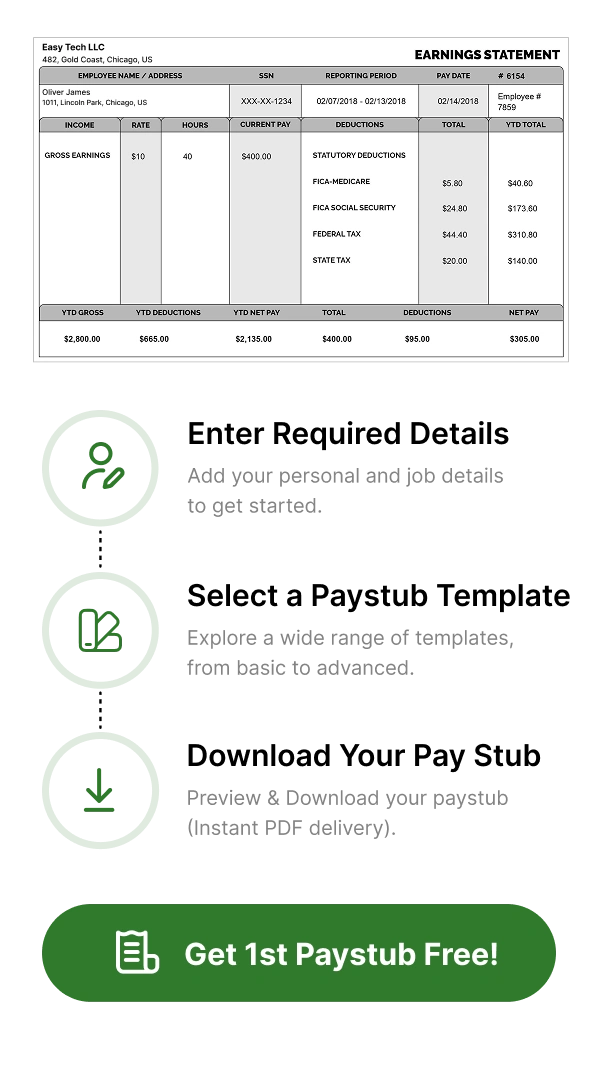
Most employees see the same silent dissatisfaction when payday arrives: the figure on their job offer letter rarely matches the amount credited to their bank account. This disparity is definitely not an error; it is simply the difference between gross pay and net pay, which are arguably the two most crucial numbers on any employee’s pay slip. Knowing both figures, the origin of each, and how deductions transform one into the other will empower you to manage your financial matters better.
This blog explains everything in simple terms. Looking for a simple way to create employee pay stubs? Our free paystub generator helps you generate professional documents quickly and easily.
What is Gross Income?
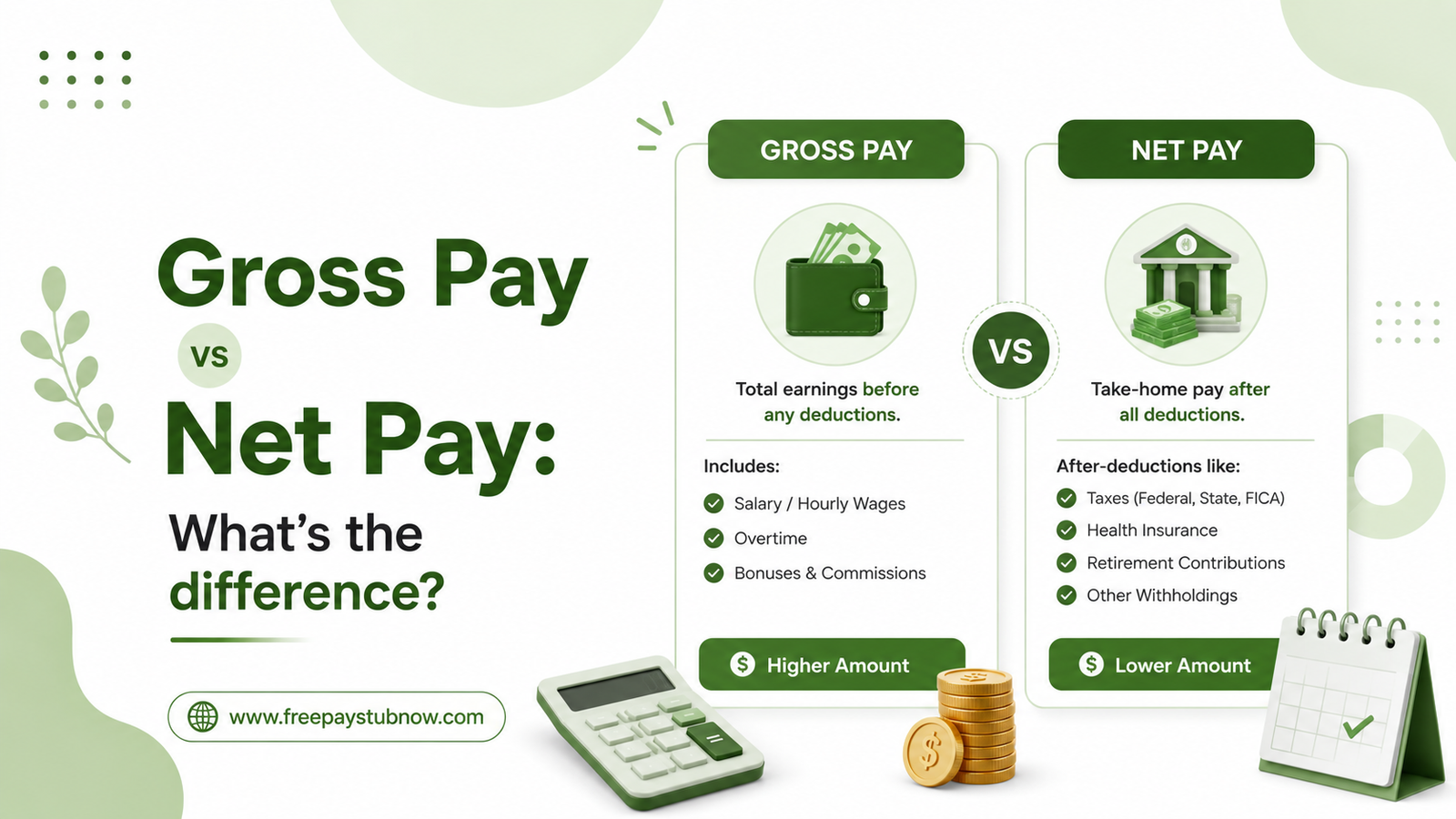
Gross pay represents the complete sum of money that you earn before the deduction of any amounts. It is the initial figure that your employer determines before any taxes, insurance premiums, retirement contributions, or other withholdings are made from your pay.
For the wage earner on a fixed salary, the gross pay is the total annual salary split over the number of paydays in the year. In contrast, for an hourly worker, gross pay is the hourly rate times the total hours worked plus any overtime, bonuses, or commissions earned during that period.
What counts as gross earnings?
Gross income includes more than just your base wages. Common components are:
- Base salary or hourly wages
- Overtime pay
- Bonuses and commissions
- Paid time off (PTO) payouts
- Tips
- Shift differentials
At its core, gross income refers to the total amount of money you receive from your employer or the person paying you before government and benefit provider deductions. On your W-2, which you get at the end of the year, you’ll see that Box 1 displays your taxable gross income, which might be a little different from your gross income when the pre-tax items (like your 401k) are factored in.
What is Net Income?
Net pay is the actual amount that you receive in your bank account or on your check after all compulsory and voluntary deductions have been taken out from gross pay. This is your genuine take-home pay, the real number that you work on for budgeting, spending, and saving.
What counts as net pay?
Net income is the amount of money left after all deductions have been subtracted from your gross pay. It is often called take-home pay because it is the actual amount you receive in your bank account or paycheck.
Net pay includes:
- Salary or wages after deductions
- Overtime pay received after deductions
- Bonuses after taxes and other deductions
- Commissions after deductions
- Any other earnings that remain after taxes, benefits, and payroll deductions
Gross Pay vs Net Pay
| Factors | Gross Pay | Net Pay |
| Definition | Total earnings before deductions are taken out | Amount received after all deductions are eliminated |
| What does it include? | Wages, overtime pay | Insurance, Retirement contributions |
| Purpose | Used to calculate taxes and payroll deductions | Used for budgeting |
| Example | $3,000 total earnings before deductions | $2,300 take-home pay after $700 in deductions |
What Gets Deducted? A Full Breakdown
1- Federal Income Tax
Federal income tax is taken out as the choices you make on your W-4 form and the IRS tax brackets based on your income level. The tax rates for 2026 will still be 10% to 37%, and the limit for each bracket has been increased to keep up with inflation. This is good news for taxpayers because it means more of your earnings can be kept tax-free by using the standard deduction (which has been increased to $16,100 for single filers and $32,200 for married filing jointly).
2- FICA taxes
FICA taxes are the easiest deductions on a pay stub because the rates are fixed by law and apply uniformly to all covered wages.
According to the IRS:
- Social Security tax: 6.2% on wages up to the $184,500 wage base limit (up from $176,100 in 2025). Once your cumulative earnings cross $184,500 in a calendar year, Social Security withholding stops for the rest of the year.
- Medicare tax: 1.45% on all wages, with no wage cap.
- Additional Medicare Tax: An extra 0.9% applies to wages exceeding $200,000 (single filers) or $250,000 (married filing jointly).
- Combined employee FICA rate: 7.65% (6.2% + 1.45%) for most workers.
3- State and local income taxes
9 U.S. states – Alaska, Florida, Nevada, New Hampshire, South Dakota, Tennessee, Texas, Washington, and Wyoming – don’t have a state income tax, so employees in these states get to keep more of their gross pay. The rest of the states either have a single-rate flat tax or a multiple-bracket progressive tax, which means even less net pay.
4- Pre-tax voluntary deductions
These deductions reduce your taxable gross income before federal and (usually) state income tax is calculated. Common examples:
- 401(k) / 403(b) contributions: Reduce your W-2 taxable income, though FICA still applies.
- Health insurance premiums (employer-sponsored, Section 125 plan): Both income tax and FICA exempt.
- HSA contributions: Triple tax-advantaged — contributions, growth, and qualifying withdrawals are all tax-free.
- Flexible Spending Accounts (FSA): The 2026 FSA limit increases to $3,400, up $100 from 2025.
- Dependent care FSA, commuter benefits: Further reduce taxable gross.
5- Post-tax voluntary deductions
These come out after taxes are applied and do not reduce your taxable income. Examples include Roth 401(k) contributions, union dues, garnishments, and certain life insurance premiums.
How to calculate net pay from gross pay?
Formula:
Net Pay = Gross Pay − Total Deductions
Steps to calculate net pay from gross pay:
Step 1: Determine Gross Pay
- Calculate total earnings before any deductions.
- Include regular wages, overtime pay, bonuses, commissions, and other taxable earnings.
Step 2: Subtract Federal Income Tax
- Based on the employee’s tax withholding information and earnings.
Step 3: Subtract State and Local Taxes (if applicable)
- Some states and local governments require additional tax withholding.
Step 4: Subtract FICA Taxes
- Social Security Tax: 6.2% of taxable wages (up to the annual wage base limit).
- Medicare Tax: 1.45% of taxable wages.
- Additional Medicare tax may apply to high earners.
Step 5: Subtract Other Deductions
- Health, dental, and vision insurance premiums
- Retirement plan contributions (401(k), 403(b), etc.)
- Wage garnishments
- Union dues and other voluntary deductions
| Deduction | Amount |
| Federal income tax | $450.00 |
| Social security | $186.00 |
| Medicare | $43.50 |
| State income tax | $150.00 |
| Health insurance premium | $120.00 |
| 401(k) contributions | $150.00 |
| Net pay | $1,900.50 |
In this example, the employee earns $3,000 but takes home $1,900.50, a difference of $1,099.50 per paycheck, or roughly 37% withheld. The exact numbers will vary based on your W-4 elections, state, and benefit choices. If you need a fast way to compute these figures automatically, you can use our free paystub maker to handle the math for you.
Why Gross Pay Matters Beyond Your Paycheck
Understanding your gross salary is not just about taxes. It matters in several broader financial and legal contexts:
Loan and mortgage applications: Lenders qualify you based on gross income, not net income. Your debt-to-income (DTI) ratio is calculated using gross monthly income, which is why your buying power on paper can look higher than your actual cash flow.
Child support and alimony: Courts typically calculate payments as a percentage of gross income in most states.
Rental applications: Landlords commonly use a 3x gross monthly rent rule to assess affordability.
Government benefit eligibility: Programs like Medicaid, CHIP, and ACA marketplace subsidies use modified adjusted gross income (MAGI), which is derived from gross income.
Social Security benefits: Your future Social Security retirement benefit is calculated based on your lifetime earnings history, which tracks gross wages rather than net.
Gross vs Net Pay for Self-Employed Employees
For freelancers and independent contractors (1099 workers), the gross vs. net calculation looks different:
- There is no employer withholding, so no taxes are deducted automatically from payments received.
- Self-employed individuals pay self-employment tax of 15.3% (both halves of FICA, 12.4% Social Security + 2.9% Medicare) on net self-employment income.
- Quarterly estimated tax payments must be made directly to the IRS to avoid underpayment penalties.
- Gross income for self-employed workers is total revenue before business expenses; net income is what remains after legitimate deductions.
How to Read Your Pay Stub?
Your pay stub is a line-by-line record of the journey from gross to net. Here is what to look for:
- Gross Pay (Current): Total earnings for this pay period
- YTD Gross: Cumulative gross earnings for the calendar year — useful for tracking when you will hit the Social Security wage base
- Federal Withholding: Federal income tax withheld this period
- OASDI / Social Security: Your 6.2% contribution
- Medicare: Your 1.45% (or 2.35% if you cross $200K)
- State Tax: State income tax withheld
- Pre-Tax Deductions: Benefits elected under a Section 125 cafeteria plan
- Post-Tax Deductions: After-tax benefit contributions, garnishments
- Net Pay: What you actually receive
Key Takeaways
The difference between gross pay and net pay is not a mystery to decode; it is a predictable, calculable result of tax law, benefit elections, and individual financial decisions. When you understand gross salary meaning and net salary meaning, you can budget more accurately, negotiate more confidently, and plan your finances with clarity rather than confusion.
FAQs
1) What is the difference between net pay and gross pay?
Gross pay is your total earnings before any deductions are made. Net pay, often called take-home pay, is the actual amount that gets deposited into your bank account after all required withholdings and deductions are subtracted.
2) What is the difference between net pay and gross pay in CTC?
The CTC includes direct, indirect, and savings benefits, whereas the gross salary is your total income before taxes and deductions. It is the net salary that reflects your actual earning potential.
3) What is gross income vs. net income?
Gross income is your total earnings before any deductions, while net income is the amount that remains after subtracting taxes, fees, and expenses. Think of gross income as your total revenue or salary, and net income as your actual take-home profit or pay.
4) Is it better to be paid in gross or net?
Paying gross wages helps your employee when it comes to applying for mortgages and loans, as the bank will want to know their gross wage. The same applies to employers when asked for evidence on how much they spend on childcare.
5) What does $5000 net mean?
The net salary must be received by your employee. This is gross pay minus every deduction: federal land tax, Social Security, Medicare, health insurance, retirement contributions, and anything else they elect. This is the category that is also indicated in their bank account.
6) How much is $5 a day for 40 years?
Saving $5 a day for 40 years equals exactly $73,000 in total contributions (5 × 365 days × 40 years). However, if you invest that money rather than just keeping it in cash, compound interest can grow your fund into a massive nest egg ranging from $359,000 to over $1.3 million.
7) How much is $70,000 a year weekly?
A $70,000 annual salary breaks down to $1,346.15 per week (gross pay) before taxes and deductions, assuming a standard 52-week working year.
8) What’s better, net pay or gross pay?
Net salary is better for establishing your day-to-day non-public price range, while gross salary is better for career negotiations and assessing your ordinary benefits. One is not always objectively higher than the opposite; as opportunities, they engage in high-quality monetary operations.
9) What is the difference between net pay and gross pay in CTC?
The CTC consists of direct, indirect, and savings benefits, while the gross salary is your normal earnings before tax deductions, and it is the net income that demonstrates your real income potential.
10) What does $5000 net mean?
$5000 net means you take home exactly $5,000 in actual money after all deductions are taken out. This is your take-home pay.