If you’ve been wondering, what is OASDI on my paycheck? Well, you’re not the only one. In fact, OASDI is one of the most frequently asked questions related to paycheck deductions, and the answer is really quite significant and life-changing for most people. Being OASDI a deduction, it isn’t just a random withholding or a clerical quirk; it is a legally irrevocable federal payroll tax that financially supports one of the greatest social safety nets ever created in U.S. history: Social Security. From income verification to payroll recordkeeping, a dependable free pay stub generator can help meet your documentation needs.
This guide covers everything you need to know about OASDI, what it stands for, what it funds, how it’s calculated, what the 2026 limits are, who is required to pay it, and how to accurately read it on your pay stub.
What is OASDI?
OASDI refers to Old-Age, Survivors, and Disability Insurance. It is the formal federal government term for Social Security tax, the payroll deduction that brings funds for retirement benefits, survivor benefits, and disability insurance for qualified American workers and their dependents.
What is OASDI Tax?
The OASDI tax is a federal payroll tax collected under the Federal Insurance Contributions Act (FICA). FICA is the broader legislative structure that authorizes two separate payroll taxes: OASDI (Social Security) and Medicare (hospital insurance). Both appear on your pay stub, but they are separate programs with separate rates and separate rules.
In the U.S., one of the least changing tax rates is that of the OASDI at 6.2% for employees since 1990. Besides, your employer has to match your 6.2% contribution, so 12.4% of your wages in total is what gets contributed to the Social Security system on your behalf every payroll period. Your employer’s part of the contribution won’t be reflected in your pay stub because that is the cost the employer, not the employee, pays.
When you see a line on your pay stub labeled as:
- OASDI
- Fed OASDI/EE
- Social Security Tax
- SS Tax
- FICA — Social Security
The phrase /EE in Fed OASDI/EE just refers to employee, implying that this portion of the tax belongs to the employee. Various payroll software programs tend to use different names, which is often a reason for misunderstanding, but the fundamental calculation is invariably the same.
Is the OASDI tax mandatory?
In most cases, OASDI tax is mandatory for employees and employers in the United States.
OASDI, also known as Old-Age, Survivors, and Disability Insurance, is the Social Security tax that brings funding for retirement, disability, and survivor benefits.
Who must pay OASDI tax?
The following entities must pay the OASDI tax:
- Employees: Most workers have OASDI tax automatically withheld from their paychecks.
- Employers: Employers are required to match the employee’s OASDI contribution.
- Self-Employed Individuals: Must pay both the employee and employer portions through self-employment taxes.
Are there any exceptions?
- Certain state and local government employees are covered by alternative retirement systems.
- Some nonresident aliens are working under specific visa categories.
- Members of certain religious groups who qualify for an exemption.
- Some foreign government employees and international organization workers.
What is the OASDI deduction?
The OASDI deduction is simply the Social Security tax that’s taken out of a worker’s paycheck. OASDI stands for Old-Age, Survivors, and Disability Insurance. It is a federal initiative that offers retirement, disability, and survivor benefits to qualified employees and their dependents.
When you earn wages, a portion of your paycheck is deducted and sent to the Social Security system. This deduction helps fund:
- Retirement benefits for eligible workers
- Disability benefits for workers who become unable to work
- Survivor benefits for spouses, children, and dependents of deceased workers
The 2026 OASDI Tax Rate and Wage Base Limit
This is the point where getting a hold of the OASDI deduction can make a real difference in your money management.
Basically, the OASDI or Social Security tax is only deducted from the first part of your earnings. Beyond a certain point known as the Social Security wage base or taxable maximum, no more OASDI will be deducted from your paycheck for that year.
In 2026, the OASDI wage base limit is $184,500. This is a raise of $8,400 from 2025’s limit of $176,100 and a step up from $168,600 in 2024. The SSA makes this ceiling change every year based on variations in the National Average Wage Index, so the wage base moves and the overall growth of U.S. wages.
How Is the OASDI Deduction Calculated?
The OASDI (Social Security) deduction is calculated based on your gross wages for each pay period. For most employees in 2026, the calculation follows these parameters:
- Employee Tax Rate: Your employer withholds 6.2% of your gross wages.
- Wage Base Limit: This tax is only applied to the first $184,500 of your annual earnings. Once your cumulative year-to-date earnings reach this limit, OASDI withholding stops for the remainder of the calendar year.
- Calculation Example: If your gross pay for a pay period is $3,269.23, your employer withholds $202.69 ($3,269.23 × 0.062).
Factors That Influence Your Specific Deduction:
- Pre-Tax Deductions: Contributions to employer-sponsored HSAs, FSAs, and other Section 125 cafeteria plans are generally exempt from FICA taxes. These deductions reduce your OASDI-taxable wages, meaning you pay less in OASDI tax today, though it may also slightly lower your future Social Security benefit calculation.
- Employer Contribution: Your employer is required to pay a matching 6.2% contribution. This is a separate cost to the employer and is not deducted from your take-home pay.
- Self-Employed Individuals: If you are self-employed, you are responsible for the full 12.4% contribution on your net self-employment earnings.
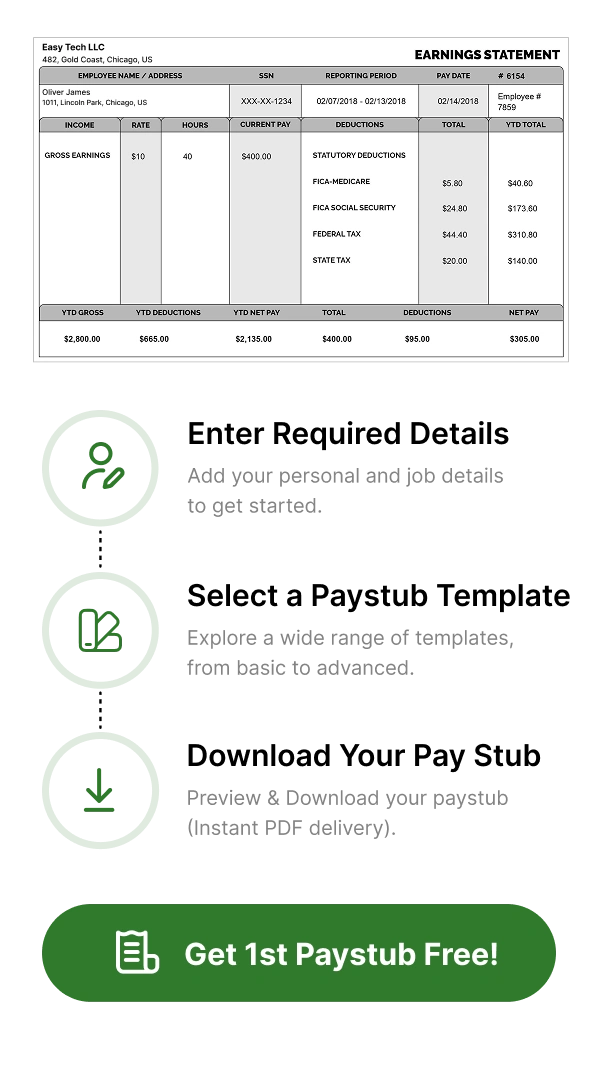
Reading Your Pay Stub Line by Line
Below is a breakdown of the reading of your pay stub line by line:
- Gross Pay: Your total earnings before any deductions.
- Federal Income Tax: Withheld based on your W-4 elections and taxable income.
- Social Security Tax: Your contribution to the OASDI program is capped at $184,500 of earnings in 2026.
- Medicare Tax: 1.45% is the contribution made to the Medicare hospital insurance program.
- State and Local Income Taxes: Varies by state and municipality.
- Net Pay: What you actually take home after all deductions are made.
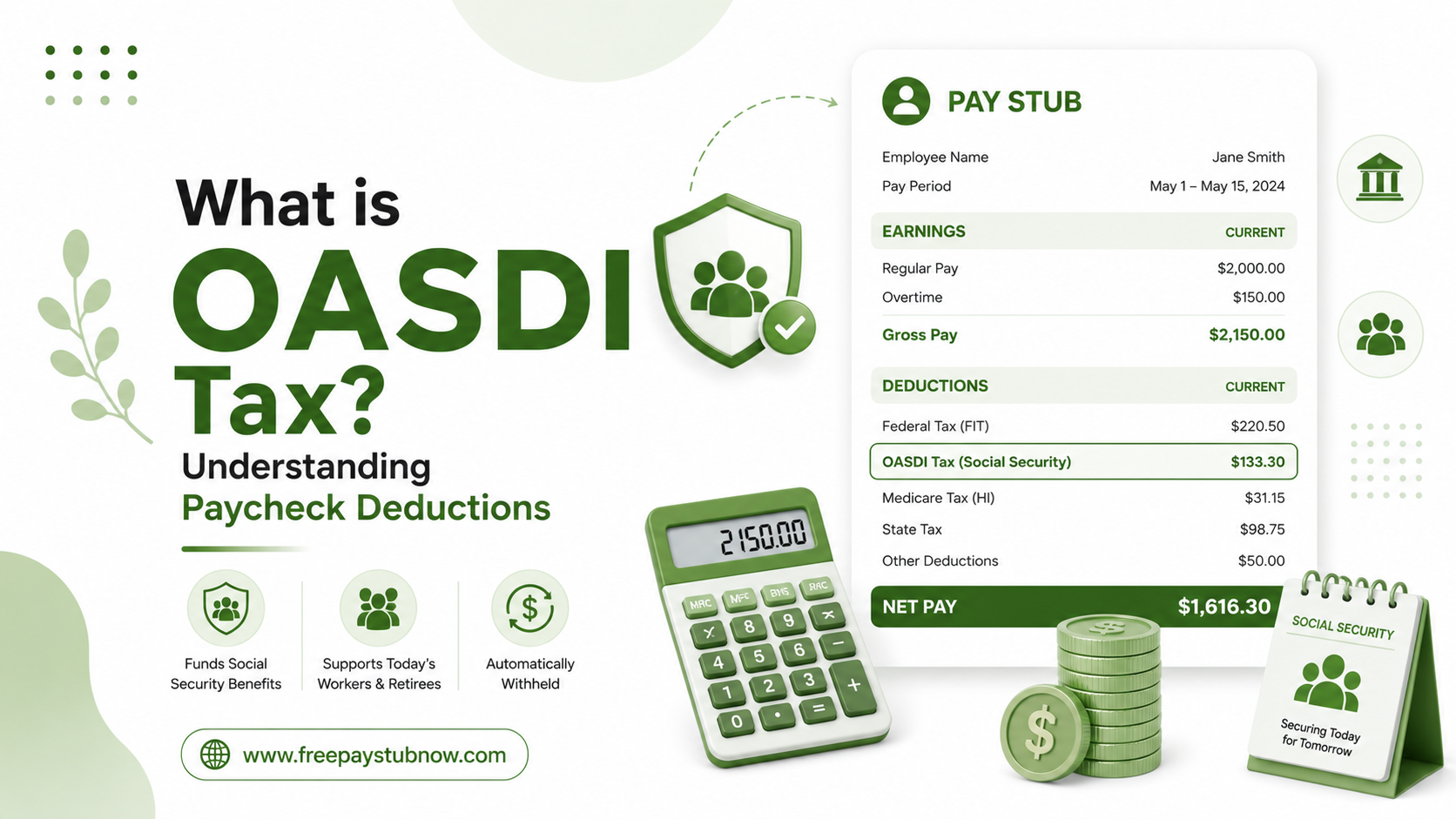
You will usually find the OASDI deduction displayed at the very beginning of the tax withholding part of your pay stub. It is most of the time put together with the Medicare line under the overall name FICA. For example, some pay stubs have just one FICA entry representing both Social Security and Medicare, while others list them separately. If you desire to double-check your OASDI calculation, simply get your gross earnings for that period and multiply them by 0.062. If the outcome corresponds to the OASDI item on your pay stub, then your payroll department is doing the right thing.
What Happens to Your OASDI Contributions?
OASDI (Old-Age, Survivors, and Disability Insurance) contributions are the payroll taxes deducted from your paycheck to fund the U.S. Social Security program. These contributions do not go into a personal savings account. Instead, they are used to pay benefits to current retirees, disabled workers, and eligible survivors of deceased workers.
Your OASDI taxes help support:
- Retirement Benefits: Monthly payments for eligible retirees who have earned enough work credits.
- Disability Benefits: Financial assistance for workers who become disabled and can no longer work.
- Survivor Benefits: Benefits for spouses, children, or dependents of deceased workers.
Even if your contributions aren’t kept in a separate account in your name, the amount of earnings and taxes you earn throughout your career is recorded through the Social Security Administration (SSA). This income report is used to calculate your Social Security benefits.
Key Takeaways
The OASDI deduction on your paycheck isn’t some secret fee; it really represents something important in the US retirement and disability support system. It’s in federal law, and basically everyone who’s working gets it applied to them. That 6.2% of your gross wages (capped at $184,500 for 2026) is actually one of the biggest amounts that can be withheld from your paycheck.
Knowing what the OASDI tax is, its calculation, and its representation on your pay stub enables you to confirm that your payroll is accurate, arrange your take-home pay, and have a clearer understanding of your overall finances. So, whenever you see the OASDI entry on your paycheck, you will understand what it is, how it is being used, and why it is important.
FAQs
1) Do I get OASDI money back?
OASDI (Social Security) is not a tax-refundable savings account. It cannot be cashed, but you can reclaim the cash in two ways: a destiny retirement/disability benefit or a tax refund for overpayments.
2) Can I opt out of OASDI tax?
The money goes to the Social Security fund and helps pay benefits. There are some exceptions to paying OASDI taxes. Religious groups: A few religious organizations and clergy members may be exempt from paying Social Security taxes if they submit Form 4029 and get approval from the IRS.
3) How do I lower my OASDI tax?
To reduce your OASDI (Old Age, Survivors, Disability Insurance, or Social Security) tax burden, you can use specific payroll techniques, modify your commercial enterprise structure if self-employed, or maximize pre-tax deductions.
4) At what amount does OASDI stop?
The OASDI limit for 2026 is $184,500.
5) Is OASDI like a 401k?
OASDI (Old Age, Survivors, and Disability Insurance) is an honorable government program called Social Security, while a 401(k) is a company-backed individual retirement account. OASDI provides an assured safety net for retirees and the disabled, while a 401(k) is an investment account that is funded and controlled.
6) How does OASDI benefit me?
It acts as a financial protection net for you and your circle of relatives, primarily providing monthly financial benefits in the event you retire, become severely disabled, or move away based on your lifetime benefits.
7) How much is OASDI in 2026?
In 2026, the maximum earnings subject to the Social Security (OASDI) tax are capped at $184,500.
8) Do I pay OASDI in retirement?
No, you do not pay OASDI (Old Age, Survivors, Disability Insurance, or Social Security) taxes on standard retirement income. However, you will pay OASDI tax anyway if you keep the paintings or earn benefits through self-employment, regardless of your age.
9) Where does my OASDI money go?
OASDI (Old Age, Survivors, Disability Insurance) payroll taxes go to the Social Security Administration to fund the monthly monetary benefit of modern retirees, qualifying disabled, and surviving spouses or children of deceased workers.
10) Why does OASDI take so much?
OASDI (Old-Age, Survivors, and Disability Insurance) is an honorable call to Social Security. It takes a substantial chunk out of your paycheck because it pays a flat 6.2% tax on your gross pay to fund the benefits of the current circle of retirees, disabled people, and relative participants and survivors.
Also Read: