
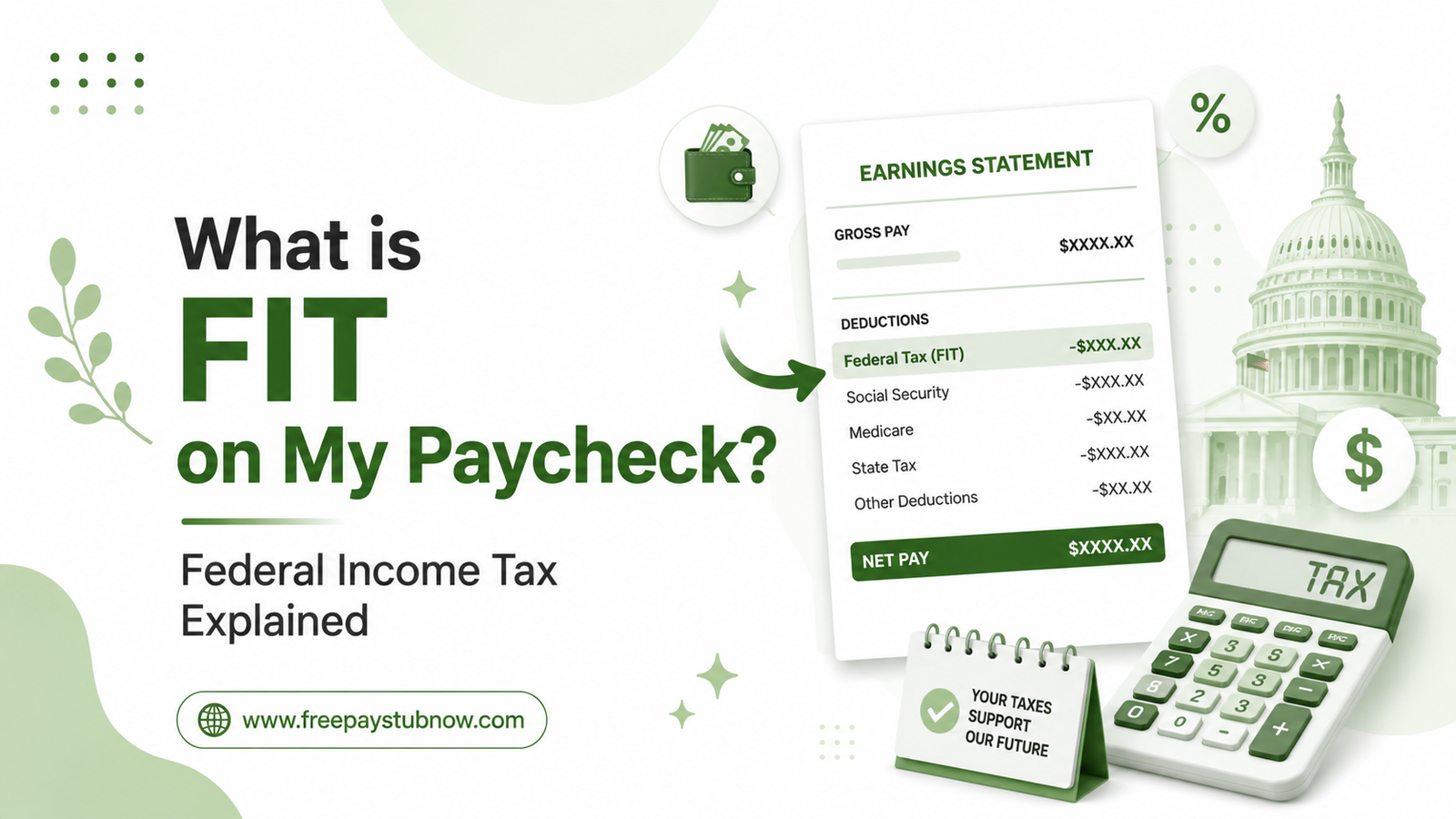
Running payroll is essentially all about FIT, the acronym that appears on every single paycheck stub you issue. Still, a lot of people, even employers, small business owners, HR managers, and new payroll administrators, are not very sure what a tax FIT really means, how it is calculated, and what the legal obligations about it actually are.
This is a guide that explains what FIT withheld is, the working of the FITW tax in reality, the usage of money collected through the tax, and precisely how the employers should behave with it in 2026. It is not negotiable for payroll compliance to get to know the meaning of FIT tax, whether you are joining your first employee or growing a team of hundreds.
What is Federal Income Tax Withholding?
Federal Income Tax Withholding (FIT) is the tax levied by the U.S. federal government on the taxable income of individuals. For employed workers, FIT is collected via a withholding system from where employers deduct a particular amount from each employee’s gross wages every pay period, and it sends the money directly to the IRS on the employee’s behalf.
FIT is a revolutionary tax, which means that as taxable earnings increase, so does the price. The machine runs through seven tax brackets from the bottom 10% to the top 37%, and the amount withheld from each paycheck is decided through the worker’s filing status, gross wages, and elections for the W-4 on the IRS form.
What is FIT on my paycheck?
Federal Income Tax (FIT) is a tax on income collected by the government. It is the segment of your salary that your employer subtracts from your paycheck and sends directly to the Internal Revenue Service (IRS) for you. Tax withholding is obligatory for most employees in the US, and it is a way to ensure that the income tax is paid during the year and not at one time when the tax return is filed.
The FIT withheld from your paycheck depends on your income, filing status, pay frequency, and the information you enter on the Form W-4. Generally, people with higher earnings will have more federal income tax taken out of their pay, while individuals who qualify for certain deductions or tax credits may have less withheld.
FIT withholding represents an advance payment toward your total federal income tax liability. Upon filing your federal tax return, the IRS checks if the total FIT withheld during the year is the same as the amount of tax you owe. If too much tax were withheld, you would get a refund. If too little was withheld, you have to pay the difference.
FIT is a deduction from payroll that ensures that workers fulfill their federal tax duties by distributing tax payments over the year via regular paycheck withholdings.
What are FITW Taxable Wages?
You might see various variations on paycheck stubs:
- FIT: Federal income tax
- FITW: Federal income tax withholding
- FIT withheld: Dollar amount of federal income tax deducted from a particular paycheck
They all talk about the same fundamental obligation. When payroll workers inquire what the FITW tax is, they are really discussing the federal income tax withholding program, a system through which employers deduct federal income tax from employees’ wages and pay it to the government regularly, instead of the employees paying a single time at the end of the tax year.
The federal income taxes that are withheld from your paycheck are used to pay for what?
Federal income taxes withheld from employee paychecks fund the general operating budget of the U.S. federal government. Unlike FICA taxes, which are marked for specific programs like FIT revenue, into the general fund of the U.S. Treasury.
FIT revenue helps pay for:
- National defense and military: Largest single discretionary expense in the federal budget
- Federal infrastructure: Bridges, airports, and transit systems
- Federal education programs: Pell Grants, Title I school funding, and student loan administration
- Scientific research and innovation: Through agencies like the NIH, NASA, and the NSF
- Federal law enforcement and judiciary: FBI, federal courts, and the Department of Justice
- Federal government operations: The legislative, executive, and judicial branches
- Interest on national debt: A growing portion of federal expenditure each year
- Means-tested assistance programs: Such as SNAP, Medicaid (federal share), housing assistance, and the Earned Income Tax Credit
FIT Tax vs FICA Tax: Major Differences
| Features | FIT Tax | FICA Tax |
| What it funds | General federal government operations | Social security & Medicare programs |
| Rate structure | Progressive | Flat |
| Who pays | Employee only | Both employee and employer |
| Based on W-4 | Yes | No |
| Wage-base limit | No | Yes |
| Employment match | No | Yes |
How FIT taxable wages work: Employer’s Step-by-Step Process
How FIT is calculated is vital for payroll accuracy. Below is a step-by-step process:
1) Collect Form W-4 from every new hire
Every new employee must complete IRS Form W-4 (Employee’s Withholding Certificate) before their first paycheck. The redesigned W-4 captures the following:
- Personal information and filing status
- Multiple jobs
- Dependents being claimed
- Extra withholding requests
2) Determine the Employee’s Taxable Wages
Employers must:
- Add any taxable fringe benefits
- Subtract any pre-tax deductions, such as traditional 401(k) contributions, HSA contributions, or pre-tax health insurance premiums
3) Apply the IRS withholding tables
Wage Bracket Method: A research table that gives accurate withholding amounts primarily based on employee salary, frequency of pay, and submission reputation. This is a simpler technique and is widely used for guiding payroll structures.
Percentage Method: Formula-based total technique adapted using automated payroll structures. The company annualizes the employee’s salary, applies the cell size, and then converts the resulting lower amount back to the withholding amount by period.
4) Deposit Withheld FIT to the IRS
Employers must deposit federal income tax withholding (alongside FICA taxes) using the Electronic Federal Tax Payment System (EFTPS). The deposit schedule, month-to-month or semi-weekly, is determined through the enterprise’s lookback length and tax legal obligations:
- Monthly depositors: Employers whose total tax liability during the lookback period was $50,000 or less.
- Semiweekly depositors: Employers whose total tax liability exceeds $50,000 during the lookback period.
5) Report FIT on Form 941
Form 941, Employer’s Quarterly Federal Tax Return, is the quarterly tax return most employers are required to file with the IRS to report total wages paid, total federal income tax withheld, and FICA taxes due. Though small employers (usually those whose annual tax liability is $1,000 or less) can be eligible for filing the Form 944 only once a year.
6) Issue Form W-2 by January 31
By year’s end, employers need to provide employees with Form W-2, Wage and Tax Statement, no later than January 31 of this year. Box 2 of Form W-2 reports total FIT withheld from the employee’s pay during the year. This amount is what the employee refers to while filing the personal income tax return to check if more tax needs to be paid or a refund is due.
Whether you’re issuing your first paycheck or running payroll for a growing team, you can create accurate, compliant pay stubs in minutes with our free paystub generator. Each stub clearly displays FIT withheld alongside gross wages, deductions, and net pay, so both you and your employees can see exactly where the money goes.
2026 Federal Income Tax Brackets: What Employers Need to Know
At least initially, withholding calculations in 2026 are based on the seven federal income tax brackets set by the IRS through annual inflation adjustments. With the enactment of the One Big Beautiful Bill Act (OBBBA) in July 2025, one of the parts of that bill made permanent the individual tax provisions of the Tax Cuts and Jobs Act, so the 2026 rate structure does not change from the present.
| Taxable income | Tax rate |
| Up to $11,925 | 10% |
| $11,926 – $48,475 | 12% |
| $48,476 – $103,350 | 22% |
| $103,351 – $197,300 | 24% |
| $197,301 – $250,525 | 32% |
| $250,526 – $640,600 | 35% |
| Over $640,600 | 37% |
For married filing jointly, the thresholds are approximately double the single filer amounts, with 37% brackets starting from $768,700.
Standard deduction for 2026:
- Single / Married Filings Separately: $16,100
- Married Filing Jointly: $32,200
- Head of Household: $24,150
These increases mean many employees will have modestly lower FIT withheld per paycheck in 2026 compared to prior years, assuming their income has not increased substantially.
FIT Withheld on Supplemental Wages & Bonuses
When paying bonuses, commissions, or other supplemental wages, the FIT withholding rules differ from regular wages:
- Flat rate method: Employers can also withhold a flat 22% of supplemental pay paid separately from regular pay, such as cumulative supplemental pay of $1 million in aggregate over the course of the year.
- 37% mandatory rate: Supplemental pay over $1 million in a calendar 12 months is essentially a 37% federal earnings tax withholding concern.
- Aggregate method: If the bonus is paid with the daily wage within the same paycheck, it would be treated as part of the daily revenue, and the blended amount is issued in the day-to-day withholding tables.
Generally speaking, the 22% flat rate is the standard option for separate bonus payments to employees. But in case the employee falls under a lower tax bracket, then it will lead to over-withholding, which the worker will be able to get back as a refund after filing their tax return.
Common FIT Withholding Mistakes Employers Make
1) Using an outdated W-4 without the Computational Bridge: If an employer employs workers who handed in W-4s before 2020, the employer has no choice other than either to use the IRS computational bridge or to request another form from the employees. Simply using the old withholding allowance logic on the current payroll tables will give wrong results.
2) Misclassifying employees as independent contractors: Independent contractors (1099-NEC) are not subject to FIT withholding through hiring transactions. But misclassifying the worker as a contractor means that the FIT is by no means closed, leaving the enterprise exposed to huge back taxes and legal obligations, penalties, and liabilities.
3) Failing to Withhold on Non-Cash Compensation: Section 61, IRS Code, specifies that non-cash benefits like personal use of a company car, group-term life insurance coverage in excess of $50,000, or taxable gifts are treated as taxable income and must be factored into the FIT withholding computations.
4) Missing Deposit Deadlines: The IRS levies fines for late FIT deposits, starting at 2% for amounts deposited 1-5 days late and going up to 15% for amounts not paid more than 10 days after the first IRS notice. It is essential for employers to be aware of their deposit schedules and to utilize EFTPS.
5) Incorrect Handling of Mid-Year W-4 Changes: If an employee submits a new W-4 mid-year, the employer must make the change no later than the first payroll period ending 30 days after the form is received. Not updating withholding on time can lead to year-end discrepancies.
FIT Withholding for Multi-State Employees
Federal taxable wages, in conjunction with the state income tax withholding, are required for employees in multiple states. Below are the key points:
- FIT withholding applies uniformly to all U.S. employees regardless of which state they work in.
- State income tax withholding is handled separately, based on each state’s rules and the employee’s state W-4 equivalent.
- Some states have no state income tax (Florida, Texas, Nevada, and a few others), but FIT still applies in all cases.
- Reciprocity agreements between certain states affect SIT but never affect FIT.
Employers with employees working in multiple states should consider payroll software that automatically handles both FIT and multi-state SIT, as manual compliance with multiple state systems is very error-prone.
Key Takeaways
Besides being just a number on your payslip, federal income tax withholding is a major legal responsibility that links an employer’s adherence to the law, an employee’s financial strategy, and the overall operation of the U.S. taxation system. Employers who want to be recognized by the IRS as trustworthy need to be able to demonstrate that they collect the right amounts of withholding, make the deposits on time, submit the correct reports, and provide the correct W-2s at the end of the year.
Fortunately, if you have a good payroll system in place, be it a very good payroll software or payroll provider, you trust that FIT compliance will be very easy to manage. The main thing is reading IRS updates regularly every year, mostly publication 15-T, making sure that a valid W-4 is kept on file for every employee, and following a regular deposit schedule.
FAQs
1) What is FIT tax mean?
FIT stands for federal income tax. It is a mandatory modern tax collected on the earnings of people and corporations with the help of the US federal government.
2) What does “FIT withheld” mean?
FIT closes the view that your corporation has deducted a portion of your earnings to prepay your federal income tax (FIT). Rather than paying you a large lump sum during tax season, this cash is immediately sent to the government on your behalf to meet your annual tax liability.
3) What does FIT mean in my paycheck?
FIT is the amount required by law for employers to withhold from wages to pay taxes.
4) How is my FIT payment calculated?
FIT bills are based on two main things: era and export (which is easiest to apply if you export energy to the grid). The generation fee is calculated using the meter reading you send us. Demeed export: Calculated based entirely on 50% of the energy you generated.
5) What does FIT stand for on W2?
Federal income tax (FIT) applies to many sources of income, including wages, bonuses, and capital gains earned by individuals and organizations. Employers must withhold each FITW and employment taxes and shared FICA contributions to Social Security and Medicare.
6) Is FIT the same as federal withholding?
A federal benefit tax withholding (FITW or FIT withholding) is the portion of an employee’s gross pay that their corporation deducts from each paycheck and forwards to the Internal Revenue Service (IRS) as a prepayment of its annual benefit tax liability.
7) What is the FIT tax in the U.S.?
Federal Income Tax (FIT) is a mandatory levy imposed by the United States federal authorities to benefit people, corporations, and certain nonresident extraterrestrials. It serves as one of the primary assets of federal revenue and funds nationwide packages that include defense, healthcare, training, and infrastructure.
8) What happens when my FIT contract ends?
When your Feed-In Tariff (FIT) contract expires, your guaranteed technology and export bills will be eliminated. These contracts typically last two decades. Fortunately, you could take care to monetize the renewable energy generated.
9) What is the FIT taxable amount?
FIT taxable wages are gross wages less taxable pre-tax deductions. Common pretax exclusions include organization-sponsored medical insurance, traditional 401(k) contributions, and HSA/FSA contributions. After-tax deductions (like Roth 401(k) contributions) do not reduce FIT taxable wages.
10) How long is the FIT payment?
Feed-in Tariff (FIT) bills are normally closed for 20 years from the date your device is modified to begin with and registered. But few solar panels hooked up before August 1, 2012, have 25-12-month contracts, and micro-CHP structures typically last for 10 years.
Also Read: